Mentioned:BA BAE SystemsMSM Group North AmericaClark Construction GroupBurns & McDonnellHensel PhelpsAlberici ConstructorsParsons Government ServicesM.C. DeanJ Kokolakis ContractingApplied Research Associates$4.2B · Contract Award
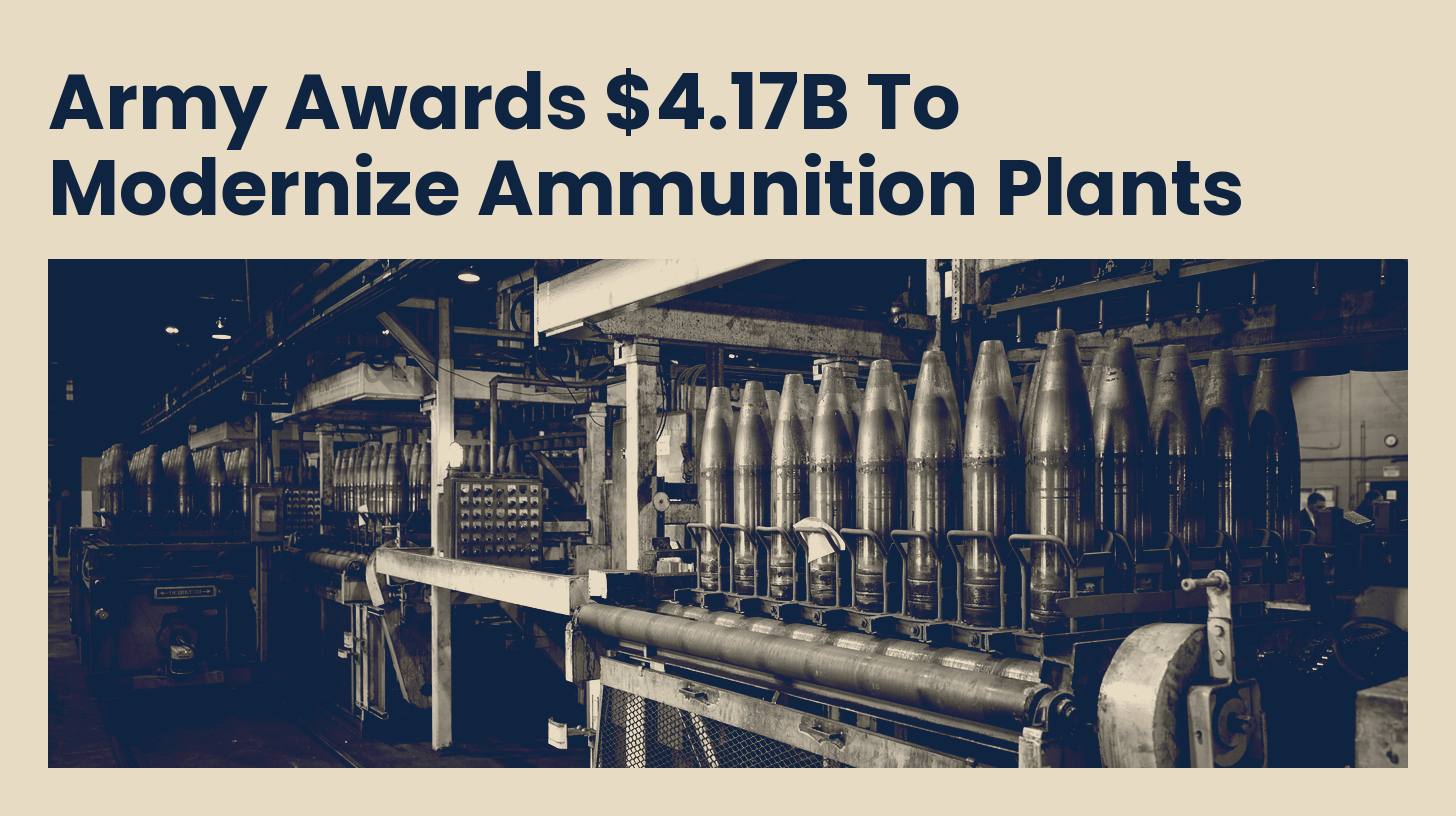
The U.S. Army awarded a $4.17 billion multiple-award task order contract to 11 companies for design, build and commissioning work at government-owned ammunition plants through 2031. The contract supports the Army's 15-year organic industrial base modernization plan as the service works toward a goal of producing 100,000 155mm artillery rounds per month.
What's happening
- The Army placed 11 companies on the contract, including BAE Systems Ordnance Systems, MSM Group North America, Clark Construction Group, Burns & McDonnell, Hensel Phelps, Alberici Constructors, Parsons Government Services, M.C. Dean, J Kokolakis Contracting, Bering-Weston JV and Applied Research Associates.
- The firm-fixed-price contract runs through November 4, 2031, and companies will compete for individual task orders as the Army modernizes plants dating back to World War II.
- Rock Island Arsenal Contracting Command will set work locations and funding with each task order; the announcement did not disclose initial obligated funds or project priority.
- The contract covers design-build-commissioning services at government-owned, contractor-operated ammunition plants including Holston in Tennessee, Radford in Virginia, Iowa, Lake City in Missouri and Scranton in Pennsylvania.
Why it matters
- The modernization addresses the Army's production constraint: as of spring 2026, the service was producing approximately 36,000 155mm rounds monthly against a goal of 100,000 monthly.
- Multiple-award task order pooling allows faster project execution than full competition for each plant upgrade, accelerating the timeline to boost ammunition output.
- The contract enables operators such as BAE and MSM to participate alongside general contractors, ensuring commissioning expertise in proving explosive and propellant processes at production rate.
- This contract supports the Army's $16 billion, 15-year organic industrial base modernization plan covering 23 depots, arsenals and ammunition plants through fiscal 2036.
Going deeper
- MSM Group North America's Future Artillery Complex at Iowa Army Ammunition Plant, designed to load 36,000 155mm rounds monthly starting in 2029, was placed on the same contract as the general builders.
- BAE Systems operates Holston since 1999 and Radford since 2012, and in December 2023 won an $8.8 billion contract to continue operating Holston for another decade.
- The Army faces persistent supply constraints beyond plant capacity: a Pentagon inspector general report in July 2026 identified metal parts as the main bottleneck, leading to separate awards to Metallus ($995 million for HF-1 steel) and Nitradyn ($581 million for IMX-104 explosive).
Financial impact
- The $4.17 billion ceiling value establishes a prequalified contractor pool; obligated funds at award not disclosed, so revenue recognition timing depends on individual task order releases.
- In fiscal 2027, the Army requested $5.47 billion for ammunition production, including $2.33 billion for industrial facilities, signaling sustained budget authority for modernization projects through this contract.
- Design-build-commissioning services under task orders will be recognized as revenue as work is completed, with timing dependent on Army project scheduling starting in 2026 through 2031.
The intrigue
- General Dynamics' effort to open two 155mm shell lines in Mesquite, Texas failed and the Army shut it down, while the service simultaneously backs multiple new production sites, suggesting uncertainty about the optimal path to 100,000 monthly rounds.
- BAE and MSM, who operate the plants being modernized, now compete against general contractors on the same contract, creating a structural advantage in cost and commissioning but potential conflicts of interest in project selection.
The fine print
- The contract is a ceiling-value multiple-award task order vehicle; actual obligated funds at award were not disclosed, and the Army will release individual task orders with specific funding as projects advance.
- All 11 bidders were placed on the contract, indicating no competitive downselect and broad industrial participation in ammunition plant work through 2031.
Source: defence-blog.com · Nov 6, 2026 · Drafted with Claude, reviewed by Industrial Base Alpha.