Mentioned:SEA LtdDecision Analysis Services LtdA2iMSI Transducers$3M · Program/Policy
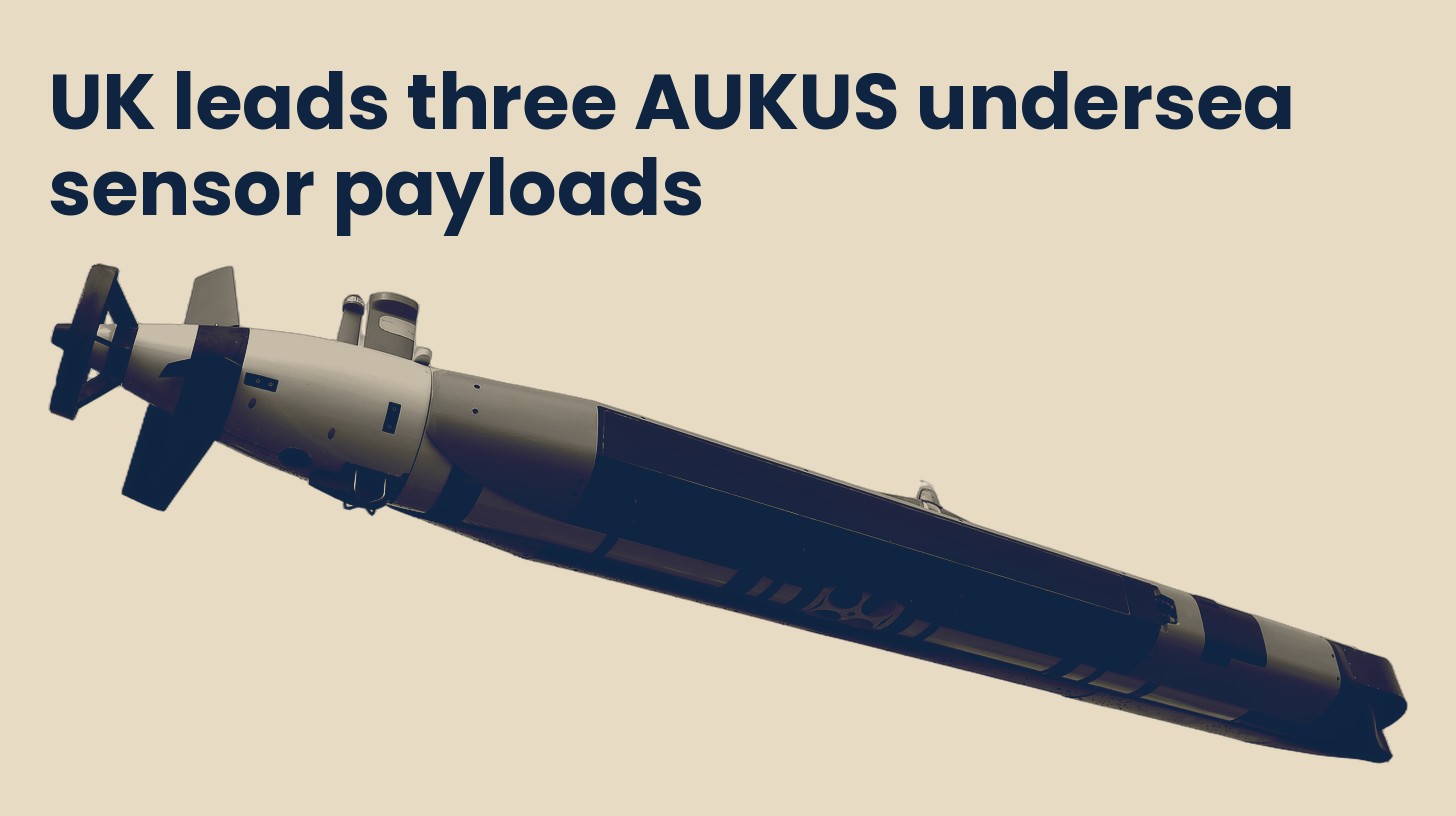
The UK announced it will lead development of three advanced undersea sensor payloads for uncrewed underwater vehicles as part of the AUKUS Pillar 2 partnership. Four companies won £3 million in funding from the Maritime Innovation Challenge following integration testing at the Maritime Big Play exercise in San Diego.
What's happening
- UK leads delivery of three sensor payloads: Synthetic Aperture Sonar, Deployable Anti-Submarine Warfare Sensor, and Deployable Non-Kinetic Effector for uncrewed underwater vehicles.
- Four companies won a share of £3 million funding under the AUKUS Maritime Innovation Challenge: SEA Ltd (Frome), Decision Analysis Services Ltd (Basingstoke), A2i (Dorchester), and MSI Transducers (US).
- Payloads will be available across Australia, UK and US uncrewed underwater vehicle fleets from 2027.
- Testing concluded at Maritime Big Play exercise in San Diego, where UK industry partners demonstrated autonomous system integration across AUKUS partners.
Why it matters
- Undersea sensor payloads extend surveillance and threat detection across large ocean areas and protect critical underwater infrastructure for three allied nations.
- Payloads enable uncrewed underwater vehicles to detect and classify submarine threats, strengthening collective deterrence across Euro-Atlantic and Indo-Pacific.
- Integration testing demonstrates operational interoperability of autonomous systems across AUKUS fleets, reducing risk in wartime coalition operations.
- Production from 2027 establishes UK supply chain for AUKUS uncrewed maritime capabilities across three nations' inventories.
Going deeper
- UK Ministry of Defence backed this work under AUKUS Pillar 2, the trilateral framework announced in May 2026 to pool innovation across three defence sectors.
- Maritime Big Play tested how crewed and uncrewed systems operate together across four strands: anti-submarine warfare, lethality, contested resupply, and subsea and seabed warfare.
- UK led anti-submarine warfare strand with thirteen uncrewed surface vehicles, two ASW targets and four underwater gliders from six industry partners.
Financial impact
- Four companies receive a share of £3 million in program funding from UK Ministry of Defence, allocated during calendar 2026.
- Revenue from sensor payload development and production will flow across 2026-2027 and beyond as payloads transition to AUKUS fleet deployment from 2027.
The intrigue
- Maritime Innovation Challenge winners include one micro-consultancy, one SME, and two large suppliers, signaling UK defence strategy to blend innovation from companies of all sizes into AUKUS delivery.
The fine print
- £3 million is shared funding across four companies; individual awards to each company not disclosed.
- Payload availability date of 2027 is a target; production and integration timelines subject to testing outcomes and manufacturing scale-up.
Source: gov.uk · Oct 27, 2026 · Drafted with Claude, reviewed by Industrial Base Alpha.