Mentioned:LUCH Design Bureau
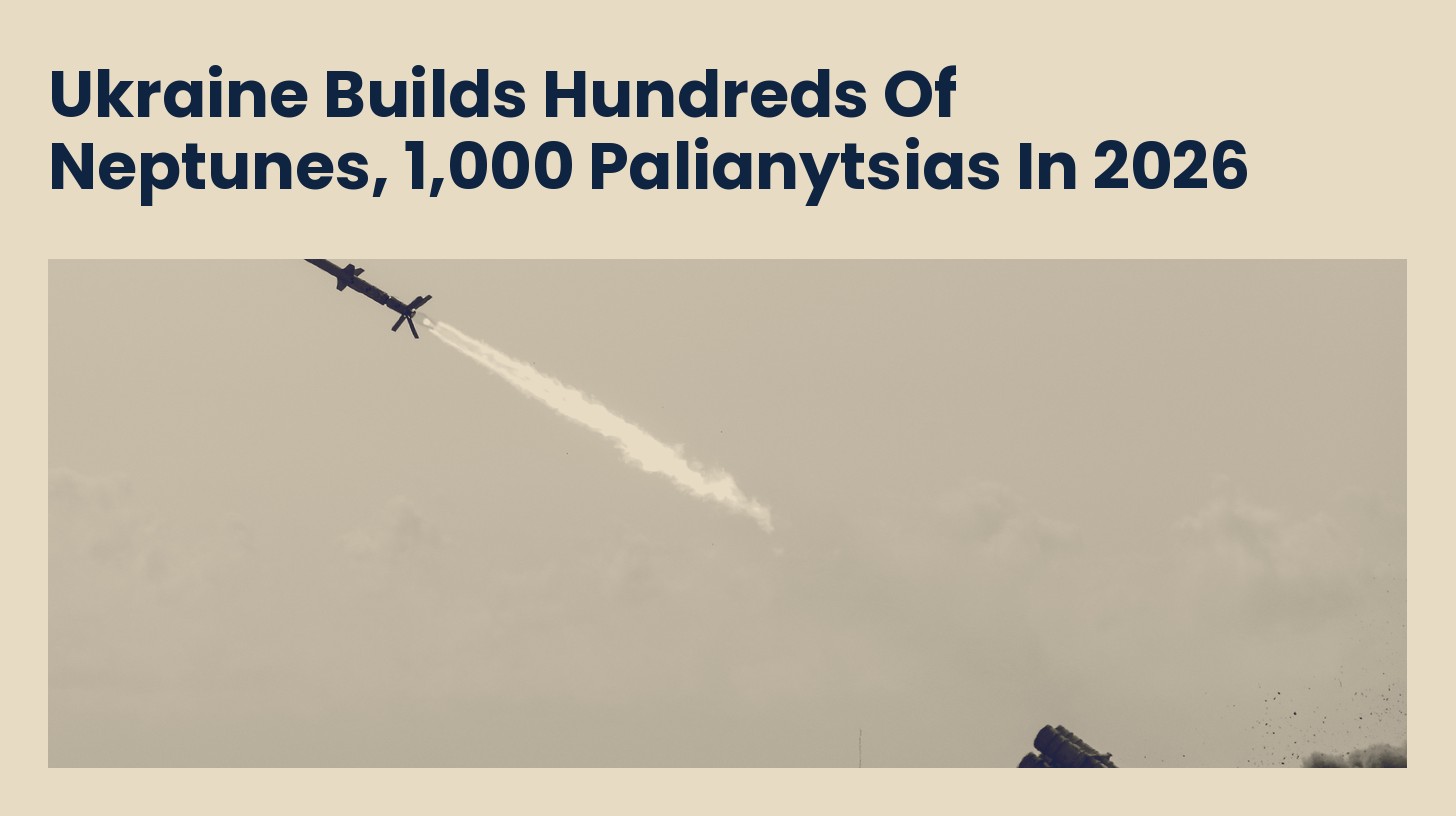
Ukraine's LUCH Design Bureau produced several hundred Neptune anti-ship cruise missiles and over 1,000 Palianytsia cruise missile-drones in 2026. Additional funding could increase Neptune output further.
What's happening
- LUCH Design Bureau produced several hundred Neptune cruise missiles in 2026, below the 1,000-unit threshold, with potential for higher output if funding increases.
- Palianytsia production already exceeded 1,000 units annually, demonstrating higher manufacturing scale than the anti-ship Neptune variant.
- Palianytsia is a turbojet-powered cruise missile with 650 km range, 350 kg total weight including 100 kg warhead, launched from trailers using solid-fuel boosters.
- Long Neptune variant has claimed 1,000 km range with 260 kg warhead and can operate without satellite navigation over complex terrain.
Why it matters
- Ukraine's domestic production of two distinct cruise missile types reduces dependence on external suppliers and sustains strike capability independently.
- Annual production rates of 1,000+ Palianytsia units indicate manufacturing capacity that can sustain ongoing operations at scale without foreign procurement.
- Neptune development began in 2010 but production funding arrived only in late 2020, illustrating how domestic munitions programs depend on sustained government investment.
- First combat use of Neptune in April 2022 demonstrated to Western allies that Ukrainian defense industry could develop and field operational systems.
Going deeper
- Neptune has two operational variants: Long Neptune with 1,000 km range and Fat Neptune with conformal fuel tanks extending range to 400-600 km.
- Areion is a derivative of Palianytsia designed for coastal and deep-strike missions with claimed 600 km range and alternative AltNav system for electronic warfare environments.
- Palianytsia cruises at 800 km/h at minimum 20-meter altitude and uses inertial navigation with satellite corrections plus electronic-warfare-resistant AltNav.
- LUCH Design Bureau CEO stated that additional funding would enable higher Neptune production rates beyond the 2026 output achieved.
Financial impact
- Timing not disclosed: revenue recognition for Ukrainian state munitions production does not apply to this private program operated by LUCH Design Bureau.
- Production scaling from hundreds to 1,000+ units annually indicates capital investment in manufacturing capacity and supply chain, though funding source and amounts remain undisclosed.
- Additional funding availability cited by LUCH leadership suggests potential for further capex and working capital to expand production, with terms and timing not disclosed.
The intrigue
- Neptune funding arrived only after the design bureau raised concerns at a presidential-level meeting in late 2020, suggesting production decisions depend on high-level political intervention.
- Palianytsia already exceeds 1,000 units annually while Neptune remains below 1,000 in 2026, raising questions about relative manufacturing difficulty and resource allocation between programs.
- Both missiles incorporate electronic-warfare-resistant navigation systems, indicating Ukraine is designing for contested environments where GPS and satellite comms may be jammed or denied.
The fine print
- Neptune production figures are stated as several hundred and below 1,000 units, leaving exact output undisclosed.
- Palianytsia production said to have already exceeded 1,000 units annually, but no calendar-year breakdown provided.
- Additional funding to increase Neptune production is conditional and not yet committed, so higher output rates remain potential rather than planned.
Source: militarnyi.com · Nov 22, 2026 · Drafted with Claude, reviewed by Industrial Base Alpha.