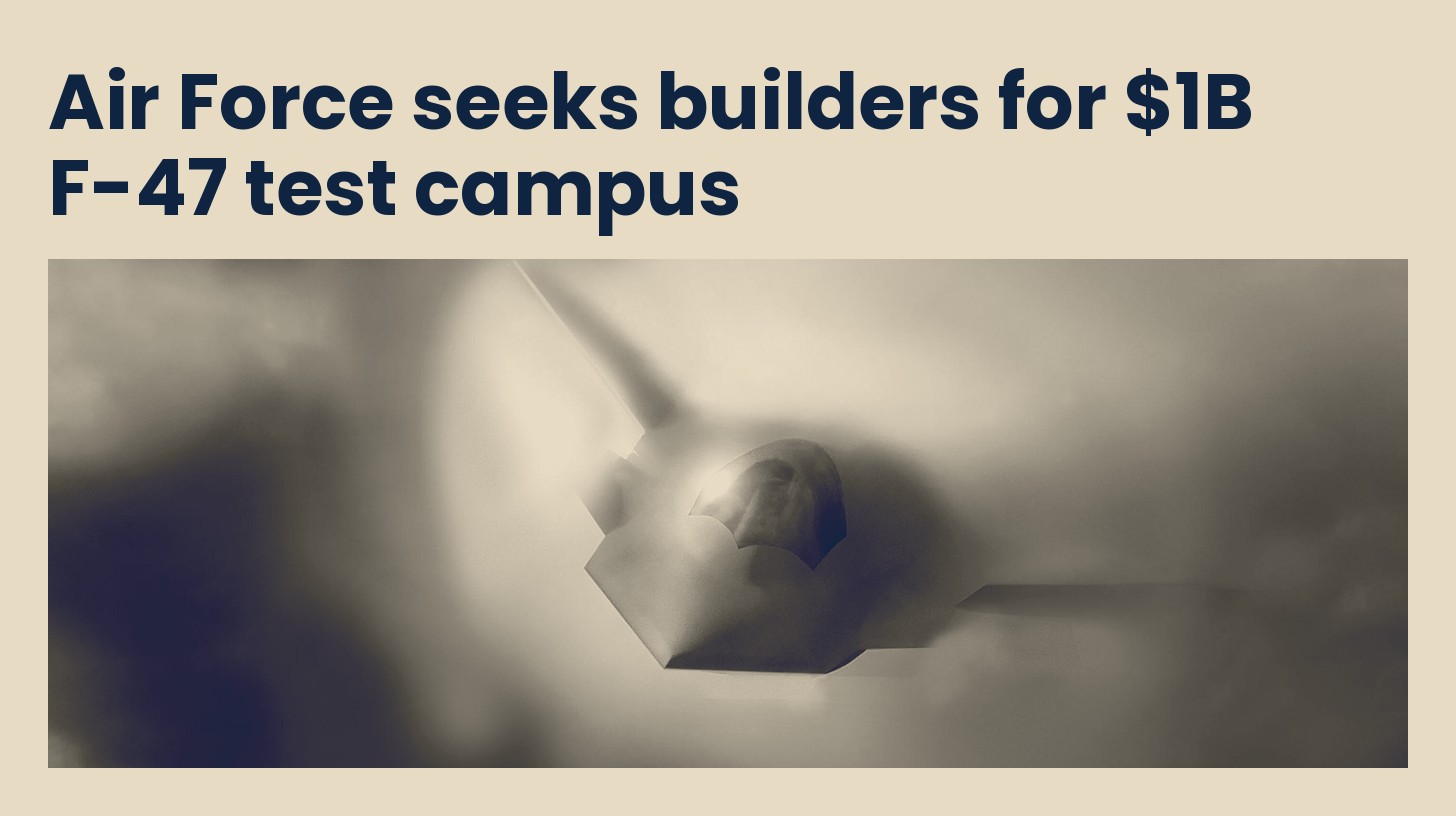
The Air Force issued a presolicitation notice for a $1.057 billion campus at Nellis AFB to house hangars, laboratories, maintenance facilities, and simulators for testing Boeing's F-47 sixth-generation fighter. The project will support operational testing ahead of the F-47's planned fleet introduction in the 2030s.
What's happening
- Air Force seeks as many as 4 qualified firms to design and build the F-47 campus in a presolicitation notice posted October 22, 2026.
- The campus includes a 117,000-square foot flightline operations and maintenance facility, a 41,000-square foot simulator facility, specialized reprogramming laboratory, and aircraft apron with sunshades.
- Initial award is planned for February 2027, with 9 months of design and preconstruction followed by 40 months of intensive construction ending March 2031.
- Potential subsequent work may include additional hangars for fuel system maintenance, stealth coating corrosion control, weapons load training, and maintenance training facilities.
Why it matters
- The campus enables operational testing of the F-47 on schedule before the fighter reaches initial operational capability in the 2030s and replaces the F-22 Raptor.
- Nellis AFB infrastructure capacity directly supports Boeing's F-47 production and test timeline, which the Air Force has prioritized as a strategic modernization effort.
- The $1.057 billion investment in dedicated F-47 testing facilities signals the Air Force's commitment to accelerating sixth-generation fighter development amid competition with China.
Going deeper
- The F-47 is designed to fly faster than Mach 2 with a combat radius exceeding 1,000 nautical miles, providing range advantages over the F-22 and F-35A in Pacific operations.
- The F-47 will eventually comprise 20 percent of the Air Force fleet and will direct semi-autonomous Collaborative Combat Aircraft drone fighters.
- Former Air Force Chief of Staff Gen. David Allvin stated in September 2025 that the first F-47 would fly in 2028, with first flight planned before the end of the current administration.
Financial impact
- The Air Force's 2027 budget proposal requested $730 million for F-47 hangars and support infrastructure, with the Nellis campus representing an additional commitment beyond that figure.
- The presolicitation and February 2027 initial award trigger a design-build contract structure with obligated and potential subsequent work, affecting contractor backlog recognition through March 2031.
- The $1.057 billion investment flows to design and construction contractors over approximately 49 months, with primary cash outlay concentrated in the 40-month construction phase beginning mid-2027.
The intrigue
- The presolicitation allows up to 4 firms to compete, raising questions about whether this enables multiple contractors to bid as a team or if the final award consolidates to a single prime.
The fine print
- The total $1.057 billion includes design, construction, security, and other expenses; not all facilities listed as potential subsequent work are guaranteed funding.
- Completion by March 2031 aligns with Air Force operational testing timelines but precedes fleet introduction in the 2030s, leaving margin for test delays.
Source: airandspaceforces.com · Oct 26, 2026 · Drafted with Claude, reviewed by Industrial Base Alpha.