Mentioned:Ocius TechnologyThales AustraliaBAE Systems Australia
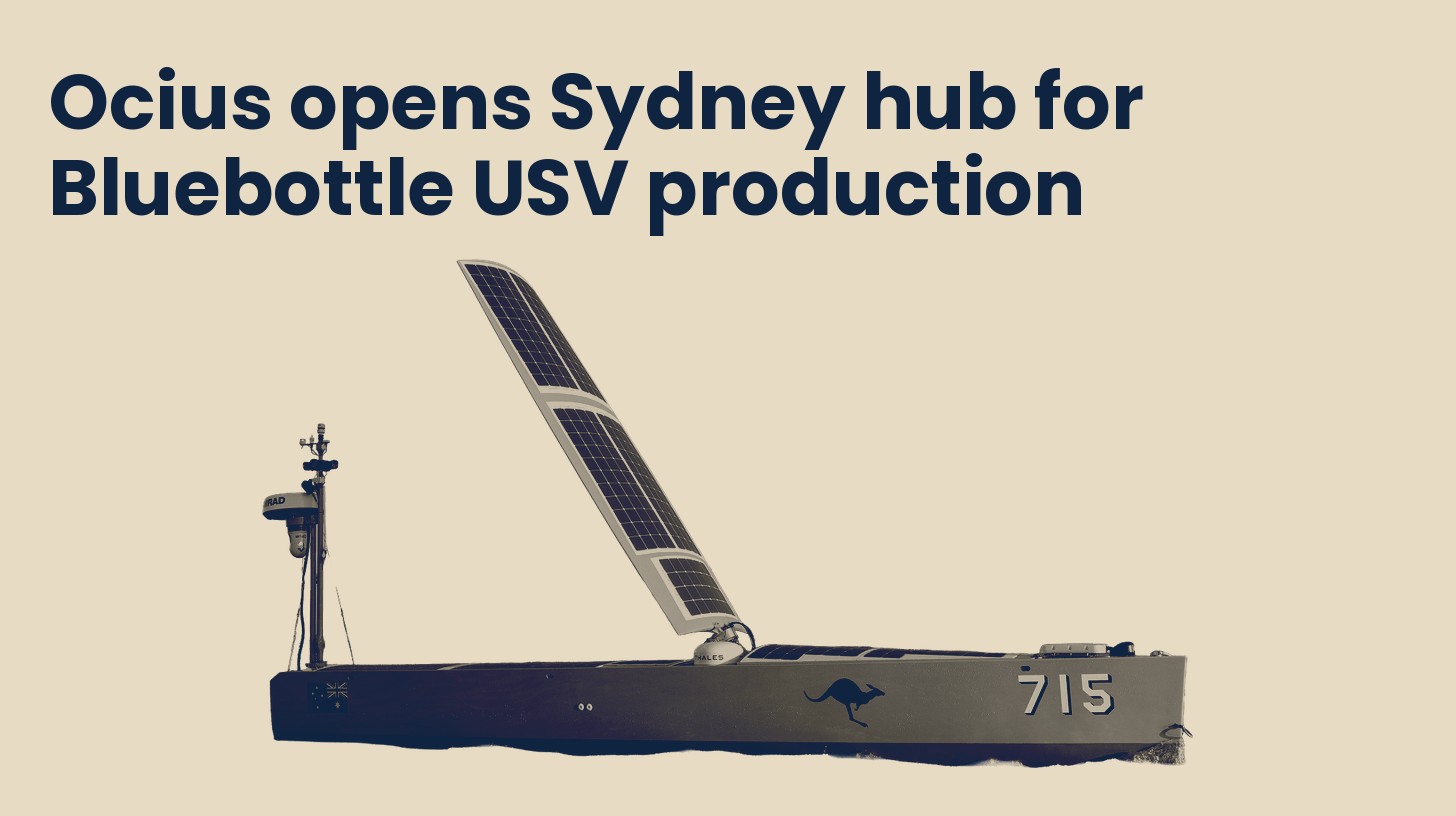
Ocius Technology opened a Sydney engineering, production and maintenance hub for Bluebottle unmanned surface vessels on October 16, 2026. Australia ordered 40 Bluebottles for A$176 million in March 2026 under Project Sea 1200.
What's happening
- Ocius opened a Sydney hub incorporating engineering, production, maintenance and a 24/7 global operations center for Bluebottle USVs on October 16, 2026.
- Thales Australia opened a multimillion-dollar assembly and manufacturing facility in western Sydney in late October 2026, jointly funded by the company and Australian government.
- Thales facility will design, manufacture and sustain BlueSentry thin-line fiber-optic sonar towed by Bluebottles and towed-array sonars for Hunter-class frigates and Collins-class submarines.
- Australia ordered 40 Bluebottles for A$176 million in March 2026, with Border Command already operating 15 additional units for northern waters monitoring.
Why it matters
- The Sydney hub consolidates sovereign manufacturing and operations for a key unmanned platform, reducing dependence on overseas production and maintenance capacity.
- Thales facility establishes end-to-end domestic sonar manufacturing for submarine and surface combatant fleets, supporting 6 incoming Hunter-class frigates and 6 Collins-class submarines.
- Bluebottle's modular payload architecture enables adaptation to evolving naval missions, creating industrial flexibility for future payload integration and capability evolution.
- The combined Ocius and Thales investments position Australia to export Bluebottles and sonar systems to regional allies, with New Zealand navy already operating 2 units and Fiji receiving donated platforms in early 2027.
Going deeper
- Bluebottle USVs are powered primarily by wind, wave and solar energy, enabling persistent at-sea surveillance for weeks without resupply.
- BlueSentry thin-line fiber-optic sonar provides submarine-hunting capability when towed behind Bluebottles, extending detection range across Australia's exclusive economic zone.
- Ocius opened its first maintenance base outside Australia in Auckland, New Zealand in early October 2026 to service regional customer platforms.
Financial impact
- Australia's A$176 million order for 40 Bluebottles in March 2026 will drive Ocius revenue recognition over the platform delivery period; timing of unit deliveries not disclosed.
- Thales facility joint funding from company and Australian government indicates shared capex investment; facility value and government contribution not disclosed.
- Ocius Sydney hub represents capex in production tooling, facility buildout and operations center infrastructure; investment amount and funding source not disclosed.
The intrigue
- Bluebottle's wind-and-solar power model creates operational persistence advantages but introduces scheduling uncertainty tied to weather patterns; how Australian Navy will operationalize persistent vs. weather-dependent deployment cycles remains unclear.
- Thales towed-array sonar production for export markets positions Australia as a regional supplier, but export approvals and foreign military sales restrictions are not detailed.
The fine print
- Thales facility is jointly funded by company and Australian government; government contribution amount and terms not disclosed.
- Bluebottle order of 40 units is the headline commitment under Project Sea 1200; individual unit delivery schedule and performance payment milestones not disclosed.
- Thales facility will sustain existing Collins-class submarine sonars, indicating ongoing in-service support contracts whose value and duration are not disclosed.
Source: Defense News · Oct 16, 2026 · Drafted with Claude, reviewed by Industrial Base Alpha.