The U.S. Senate Appropriations Committee recommends $544 million for 1,000 additional low-cost containerized missiles and 62 ground launchers. The allocation targets expanding American precision-strike capabilities and strengthening domestic munitions production capacity.
What's happening
- Senate Appropriations Committee recommends $544 million under line 18A for Low-Cost Containerized Munition, Ground Launch systems in the fiscal year 2027 defense appropriations bill.
- Funding covers procurement of 1,000 all-up rounds and 62 launchers, with no funding in the original fiscal year 2027 budget estimate.
- Pentagon framework agreements announced May 13, 2026 with Anduril, CoAspire, Leidos, and Zone 5 establish pathway for experimentation and potential fixed-price production contracts.
- Pentagon estimates could procure more than 10,000 low-cost cruise missiles across relevant portfolios over three years beginning in 2027.
Why it matters
- Proposal addresses production capacity constraints by funding distributed-launch systems that enable larger missile inventories across land and naval platforms.
- Senate emphasis on competition, advanced manufacturing, modular designs, and resilient supply chains signals effort to reduce dependence on limited traditional production pathways.
- Initiative supports sustained combat operations during high-intensity conflicts by enabling more scalable and affordable precision-strike deployment.
- Funding accelerates munitions industrial base expansion at scale, supporting Pentagon's stated goal of manufacturing effective weapons rapidly in sufficient quantities.
Going deeper
- Leidos announced November 2, 2026 expansion of supplier network and manufacturing capacity for containerized missile program, with initial missiles for testing in 2027.
- Separate $267.315 million Senate increase in fiscal year 2027 recommends 2,000 additional all-up rounds for Low-Cost Cruise Missile systems.
- Committee also recommends additional investments in affordable mass munitions, scaled hypersonic strike systems, and Multi-mission Affordable Capacity Effector.
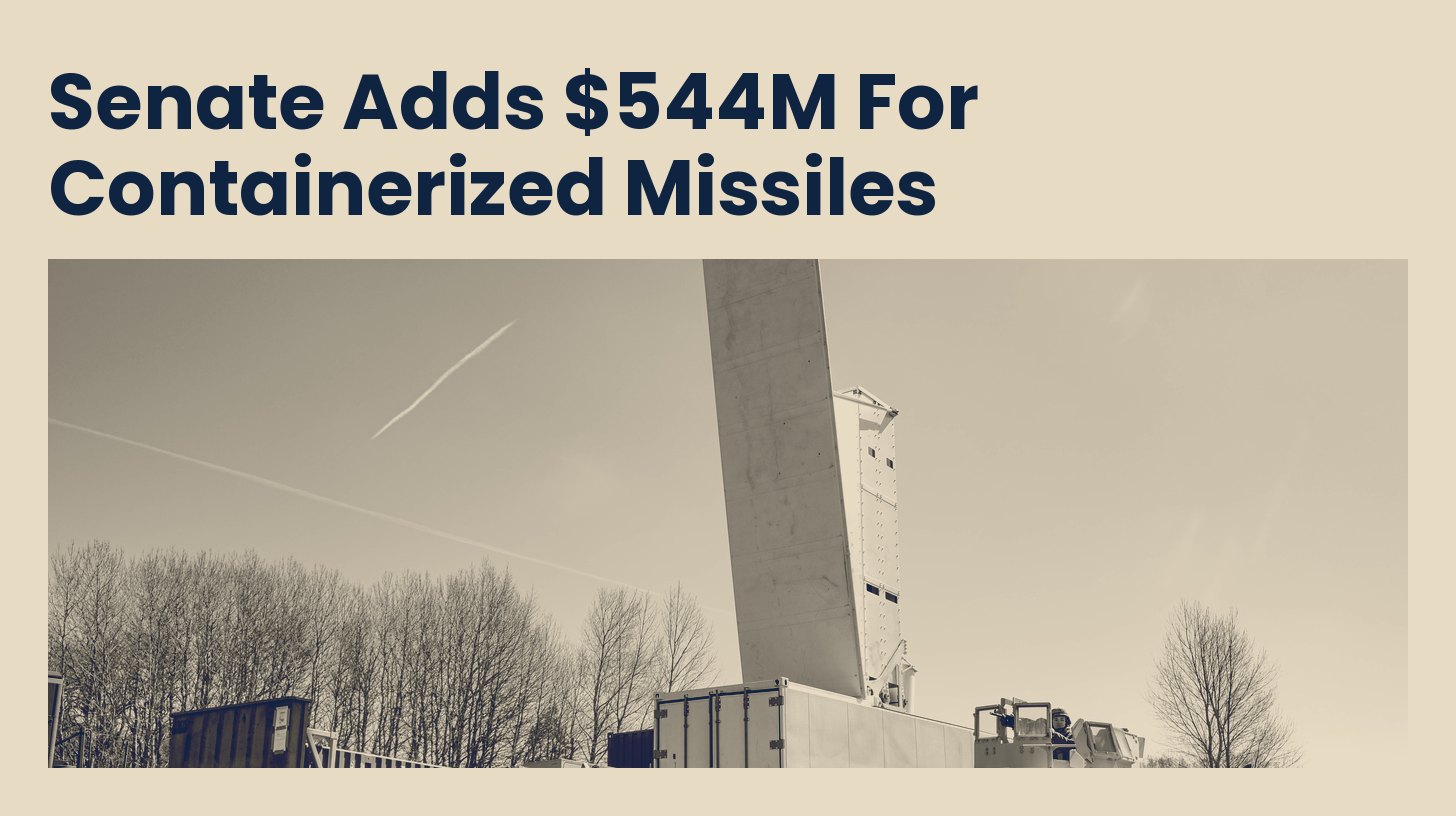
- Containerized design enables deployment from standard shipping containers, reducing logistics burden and supporting distributed firepower architecture.
Financial impact
- Recommendation of $544 million represents new budget line with no fiscal year 2027 baseline, requiring full appropriation and enactment into law.
- Potential fixed-price production contracts through Pentagon framework agreements will recognize revenue over delivery schedules starting in 2027 for participating contractors.
- Leidos and other selected contractors face capex requirements for manufacturing capacity expansion, with timing tied to full-rate production ramp beginning 2027.
- Ceiling value of $544 million obligates funding for 1,000 rounds and 62 launchers only upon final appropriation; timing of obligation and delivery spans multiple fiscal years.
The intrigue
- Senate proposal names no specific prime contractor, leaving competitive procurement path open among Anduril, CoAspire, Leidos, and Zone 5 framework partners.
- Containerized missile concept prioritizes affordability and mass production over traditional precision-weapon cost profiles, testing whether commercial manufacturing practices can sustain military specifications.
- Pentagon estimates of 10,000+ missiles over three years vastly exceed the 1,000-round Senate proposal, suggesting disagreement between congressional appropriation and Pentagon procurement timelines.
The fine print
- Senate recommendation has not yet been enacted into law and does not constitute a confirmed procurement contract or delivery order.
- Ceiling value is $544 million; obligated funds and actual delivery quantities depend on final appropriation and contractor performance milestones.
- Framework agreements establish pathway for experimentation and military utility assessment, with fixed-price production contracts conditional on satisfactory testing results.
Source: armyrecognition.com · Nov 25, 2026 · Drafted with Claude, reviewed by Industrial Base Alpha.