Mentioned:EmbraerKencoa AerospaceASTG$470M · Program/Policy
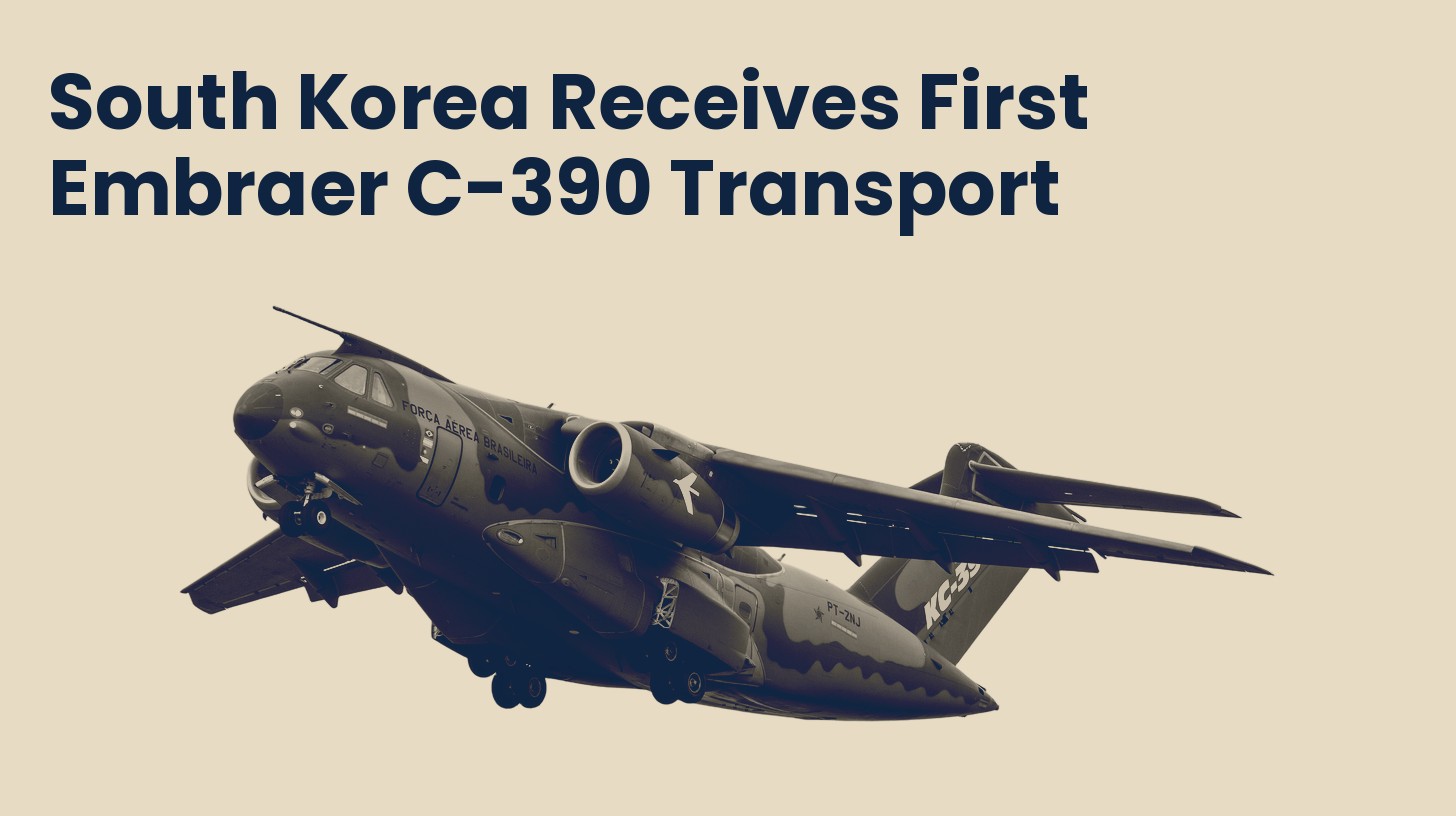
South Korea received its first Embraer C-390 Millennium military transport aircraft at Seoul Air Base on November 23, 2026, becoming the first Asian operator of the Brazilian jet airlifter. The $470 million Large Transport Aircraft II program procures three aircraft plus training, spares, and industrial offsets with Korean suppliers.
What's happening
- The Republic of Korea Air Force accepted the first C-390 Millennium (serial MSN 39000013) after a ferry flight from the Philippines, landing at Seoul Air Base at 10:52 a.m. Korean time on November 23, 2026.
- South Korea ordered three C-390s under the Large Transport Aircraft II program valued at KRW 710 billion ($470 million) in December 2023, beating offers from Lockheed Martin C-130J-30 and Airbus A400M.
- The aircraft will join the 15th Special Missions Wing alongside existing C-130H/J and CN-235 fleets, with formal handover expected in December 2026 and two remaining aircraft delivered by December 2027.
- Korean suppliers Kencoa Aerospace and ASTG secured component supply contracts totaling KRW 135.2 billion through 2030 as part of industrial offset agreements.
Why it matters
- The C-390 adds 26-tonne payload capacity and 870 km/h cruise speed to South Korea's military airlift capability, extending range to 2,000 km with full load versus existing transport options.
- Industrial offsets integrate Korean suppliers into Embraer's international supply chain alongside OGMA (Portugal), Aero Vodochody (Czech Republic), BAE Systems, and Collins Aerospace, creating potential for future production orders on C-390 exports.
- South Korea's selection of a non-U.S. transport platform diversifies its procurement and demonstrates Embraer's competitive standing in the Asia-Pacific military aviation market.
Going deeper
- The C-390 Millennium measures 35.2 m long with two IAE V2500-E5 turbofan engines generating 139.4 kN each and a maximum takeoff weight of 86,999 kg.
- Payload range varies with cargo: 26 tonnes over 2,000 km, 23 tonnes over 2,720 km, or 14 tonnes over 5,020 km; ferry range reaches 6,240 km or 8,460 km with auxiliary fuel tanks.
- Embraer completed the C-390's maiden flight in Brazil in March 2026, with the prototype first flying in February 2015 after Brazilian government funded prototype development in 2009.
Financial impact
- Embraer recognizes aircraft revenue from the KRW 710 billion ($470 million) acquisition package as South Korea takes delivery of three aircraft through December 2027.
- Kencoa Aerospace and ASTG will recognize component supply revenue totaling KRW 135.2 billion through September 2030 from the industrial offset agreements, extending cash flows across four years.
The fine print
- The aircraft will undergo acceptance procedures before formal handover in December 2026; delivery timeline for the remaining two aircraft extends to December 2027.
- The wider LTA-II program budget reached KRW 883 billion, while the acquisition package value is KRW 710 billion ($470 million), indicating additional program costs beyond aircraft procurement.
Source: armyrecognition.com · Nov 23, 2026 · Drafted with Claude, reviewed by Industrial Base Alpha.