Mentioned:SpaceWERX$30M · Program/Policy
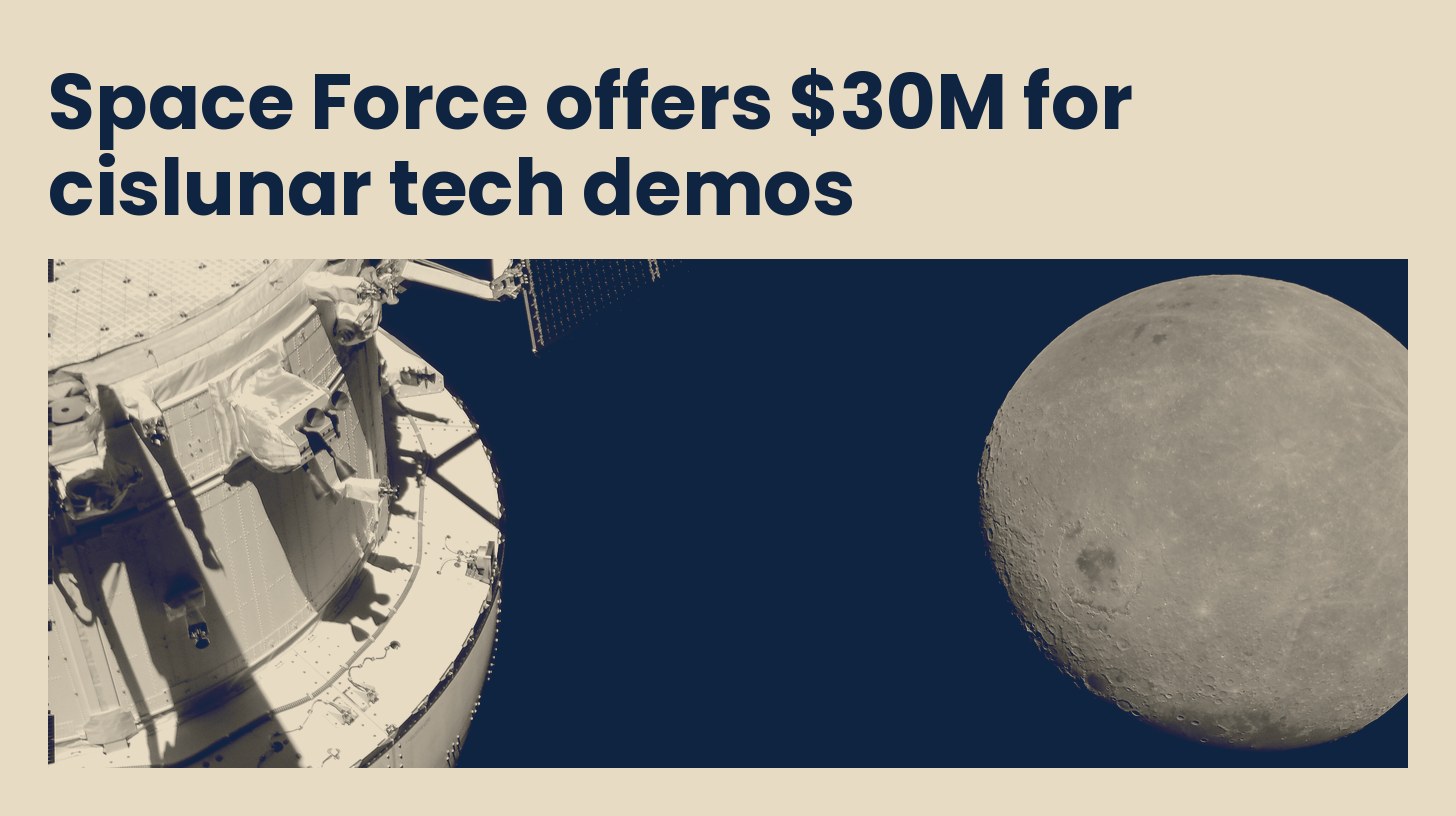
The Space Force is investing $30 million in Lunar Prime, an industry challenge targeting flight demonstrations of cislunar technology within two years of contract award. The effort reflects a strategic pivot toward cislunar operations and direct competition with Chinese lunar ambitions.
What's happening
- Space Force is funding Lunar Prime with $30 million in partnership with SpaceWERX to conduct cislunar flight demonstrations within 24 months of contract award.
- The service is releasing two requests for information: one seeking existing commercial or near-commercial hardware and software ready by 2029, and a second for fully autonomous AI systems for cislunar spacecraft.
- The Cislunar Coordination Office, established in April 2026 and led by Jaime Stearns, drafted a technology roadmap and identified mission areas including space domain awareness, communications, and lunar navigation.
Why it matters
- Cislunar operations represent a warfighting domain now receiving high-level Pentagon endorsement; Space Force had previously deprioritized cislunar planning and personnel allocation.
- China has landed multiple uncrewed lunar spacecraft and plans a crewed Moon mission by 2030, creating a capacity gap the U.S. is moving to close with accelerated timelines.
- The $30 million challenge and RFI strategy aim to leverage existing commercial solutions and reduce development cycles, compressing what would traditionally be multi-year science programs into rapid fielding efforts.
- Autonomous AI systems for cislunar spacecraft address operational challenges in a region 1,728 times the volume of geosynchronous orbit where remote command and control are impractical.
Going deeper
- The shift in cislunar prioritization follows a December 2025 executive order from President Trump and recent public statements by Defense Secretary Pete Hegseth and Chairman of the Joint Chiefs Gen. Dan Caine.
- Air Force Research Lab's Oracle program is separately planning to launch multiple cislunar space domain awareness satellites in the coming years, complementing Lunar Prime's demonstration focus.
- Cislunar space extends beyond geosynchronous orbit to the Moon and regions influenced by Earth and Moon gravity, presenting navigation and signal challenges distinct from traditional space operations.
Financial impact
- The $30 million Lunar Prime funding obligates capital in fiscal 2026 toward technology demonstrations due within 24 months of individual contract awards; revenue timing varies by contractor and milestone completion.
- RFI responses will inform follow-on procurement decisions for commercial-off-the-shelf solutions and autonomous systems with implementation target dates of 2029, creating potential incremental budget line items in fiscal 2029.
- The effort is housed within Maj. Gen. Stephen Purdy's portfolio acquisition executive account for advanced programs, indicating funding may flow through existing Space Force RDT&E or procurement lines rather than new budget authority.
The intrigue
- The Space Force is explicitly seeking non-developmental, existing commercial solutions with a two-year demonstration timeline, signaling urgency to field capability faster than traditional acquisition cycles allow.
- Autonomous AI systems for cislunar spacecraft represent a capability gap Purdy characterized as unmet until now, suggesting no single incumbent contractor currently possesses operational cislunar autonomy solutions ready for demonstration.
The fine print
- The $30 million Lunar Prime ceiling may support multiple contract awards; the obligated amount per contractor and total obligated funds in fiscal 2026 are not disclosed.
- RFIs are described as releasing imminently but had not been published as of the October 26, 2026 article date; actual solicitation terms and evaluation criteria remain to be defined.
- Flight demonstration timelines begin 24 months after contract award, meaning actual mission dates depend on award timing and contractor execution, with no fixed government demonstration date specified.
Source: airandspaceforces.com · Oct 26, 2026 · Drafted with Claude, reviewed by Industrial Base Alpha.