Mentioned:No public companies identified
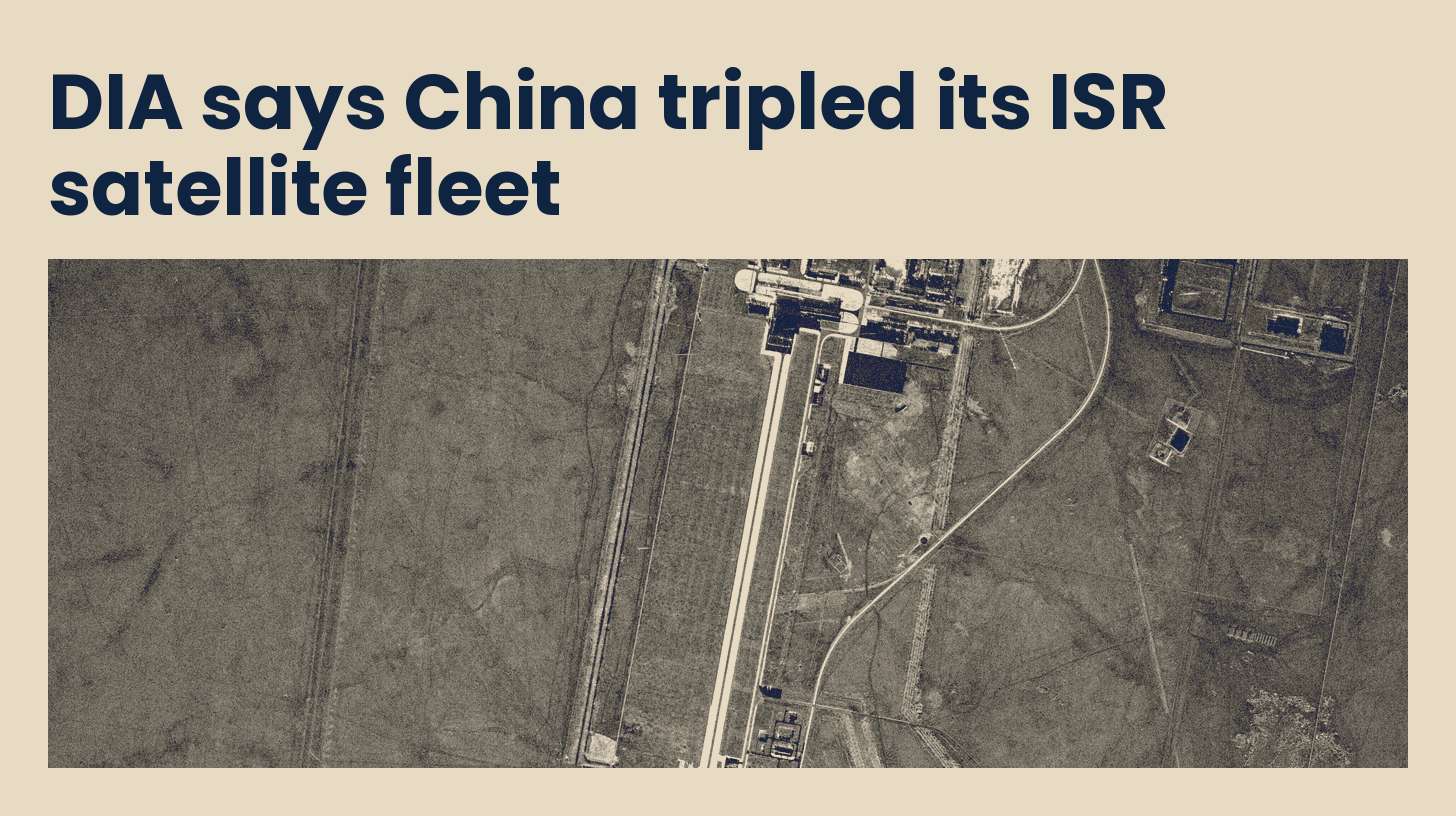
The Defense Intelligence Agency released its 2026 Challenges to Space Security report, revealing China has tripled its ISR satellite constellation to over 510 operational units since 2018. The expansion signals accelerating PLA capabilities to monitor and target US and allied forces globally, particularly across the Indo-Pacific region.
What's happening
- China's ISR satellite fleet grew from approximately 141 operational units in 2018 to over 510 as of July 2026, according to the DIA.
- The constellation includes electro-optical and synthetic aperture radar imagery satellites, plus electronic and signals intelligence platforms enabling global monitoring.
- DIA acknowledges the 510-unit count includes both People's Republic of China and Chinese commercial firm satellites, reflecting military-civil fusion policies.
- Chinese commercial firms supply imagery to state actors banned by Western providers, the report states.
Why it matters
- The expanded ISR network enhances PLA's ability to build kill chains that could detect, track and target US joint forces in the air and undersea domains.
- Coverage across the Indo-Pacific, including the Korean Peninsula, Taiwan, Philippines, Indian Ocean and South China Sea, directly threatens US and allied operational security.
- Dual-use commercial satellites blur the line between civilian and military space infrastructure, complicating attribution and escalation risks.
- The technological advancement in low-Earth orbit systems and reusable spaceplanes signals China is closing capability gaps in space-based surveillance and strike.
Going deeper
- The DIA report notes China's operational surveillance and weather satellite fleet has grown from 141 to 541 units, while its surveillance-only fleet increased from 124 to 453.
- American Enterprise Institute analysis shows the US maintains 643 operational surveillance and weather satellites as of 2026, up from 298 in 2018, outpacing Chinese expansion.
- The report includes the first public image of China's reusable spaceplane, widely believed modeled after the US X-37B and launched as recently as February 2026.
- Future threats identified include rapid orbital congestion, AI integration, collision risks from non-maneuverable debris, and proliferation of very-low Earth orbit satellites.
The intrigue
- AEI analysts note the DIA's count methodology lacks clarity on which satellites qualify as ISR, and the actual growth rate has slowed in recent years despite the tripled total.
- The report identifies Chinese commercial firms supplying imagery to weapons-proliferation actors, raising questions about how imagery sales fund military development.
The fine print
- The DIA report is unclassified and represents the third in a series begun in 2019; it covers threats from China, Russia and emerging space powers.
- The 510-unit figure includes both state and commercial satellites, making operational vs. non-operational status unclear.
- The report predicts space will become increasingly congested and competitive as counterspace capabilities proliferate among China, Russia, Iran and North Korea.
Source: Breaking Defense · Oct 27, 2026 · Drafted with Claude, reviewed by Industrial Base Alpha.