Mentioned:Rendezvous Robotics$20M · Series B
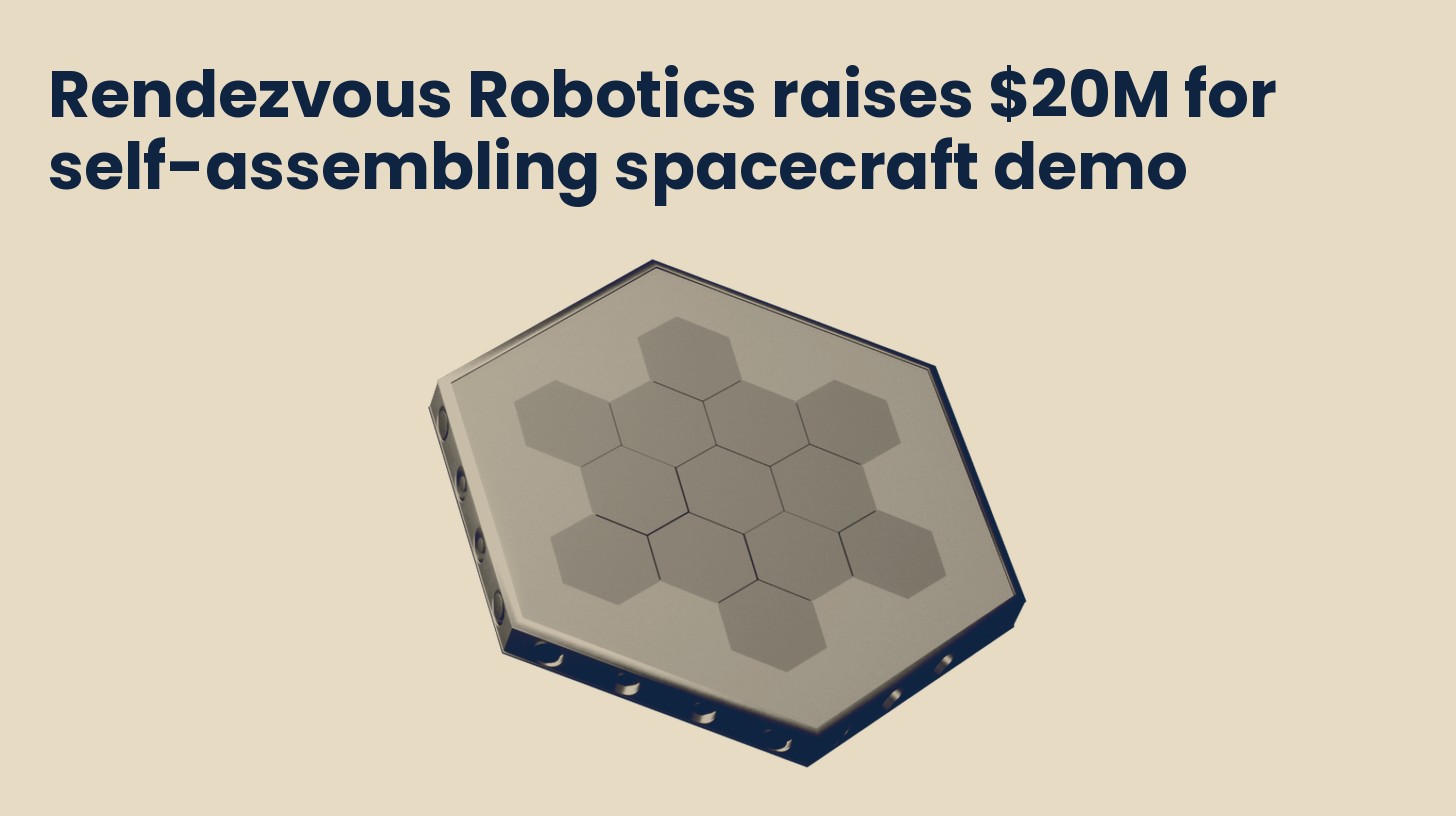
Rendezvous Robotics closed a $20M Series B led by MaC Venture Capital and Toyota Ventures to advance self-assembling spacecraft technology. The company plans an orbital demonstration of seven hexagonal tiles assembling in vacuum by April 2028.
What's happening
- Rendezvous Robotics raised $20M in Series B from MaC Venture Capital, Toyota Ventures, University of Michigan Endowment, Astera Ventures, Industrious Ventures, Aurelia Foundry, ATX Venture Partners, and Mana Ventures.
- The company is developing approximately 1-meter hexagonal tiles that use electromagnetic fields to self-assemble in vacuum, with each tile equipped with sensors and onboard processing.
- Rendezvous Robotics plans to launch 32 tiles to the ISS no earlier than December 2026 for testing inside the space lab.
- An orbital demonstration mission launching no earlier than April 2028 will send seven tiles to vacuum for the first time to validate self-assembly and reconfiguration capabilities.
Why it matters
- Modern satellites are outgrowing available rocket fairings with larger solar arrays, antennas, and power systems, creating a production bottleneck for the satellite industry.
- In-space assembly addresses satellite operators' inability to service, reconfigure, or replace failed components after launch without entire mission redesigns.
- The modular tile approach enables autonomous physical reconfiguration in orbit to optimize performance or route around degraded components, extending satellite operational value.
- Successful orbital demonstration de-risks a production solution for large-aperture communications and Earth-observation satellites that currently cannot fit existing launch vehicles.
Going deeper
- The technology builds from nearly a decade of research by cofounder Ariel Ekblaw through the TESSERAE program at Massachusetts Institute of Technology.
- Prior flight testing includes zero-gravity aircraft missions, one suborbital flight, and two missions to the ISS, all demonstrating proof-of-concept in controlled environments.
- Each tile can support different satellite subcomponents including computers, solar panels, propulsion systems, and radiators, allowing modular customization.
- Long-term applications include orbital depots staging replacement tile sets for rapid deployment to repair or upgrade satellites already in service.
Financial impact
- Series B funding of $20M increases Rendezvous Robotics' cash position and extends runway to execute the April 2028 orbital demonstration. Timing not disclosed on when capital will be deployed or cash burn rate.
- The funding structure and dilution from this round are not disclosed. Company remains private with no announced path to public markets or exit.
The intrigue
- CEO Joe Landon stated long-term vision includes orbiting tile depots for on-demand parts delivery, a model that could disrupt satellite manufacturing if demonstrated successfully.
The fine print
- The April 2028 orbital demonstration date is described as 'NET,' meaning no earlier than, introducing timing risk.
- The ISS testing mission is scheduled no earlier than December 2026, also subject to NASA scheduling and ISS availability.
- Terms of Series B including valuation, investor ownership stakes, and any board seat arrangements are not disclosed.
Source: payloadspace.com · Oct 28, 2026 · Drafted with Claude, reviewed by Industrial Base Alpha.