Mentioned:Biosphere$21M · Contract Award
The Pentagon awarded $21 million to California-based biotech startup Biosphere to construct a 20,000-liter bio-manufacturing facility that will produce critical military chemicals using genetically engineered microorganisms. The facility, scheduled for commissioning in Q4 2027, addresses Pentagon priorities to rebuild domestic production capacity and reduce reliance on foreign suppliers, particularly China.
What's happening
- Biosphere will build a 20,000-liter bio-manufacturing facility using genetically engineered microbes to produce chemicals for military applications including polymer-bonded explosives for weapons like the Hellfire missile.
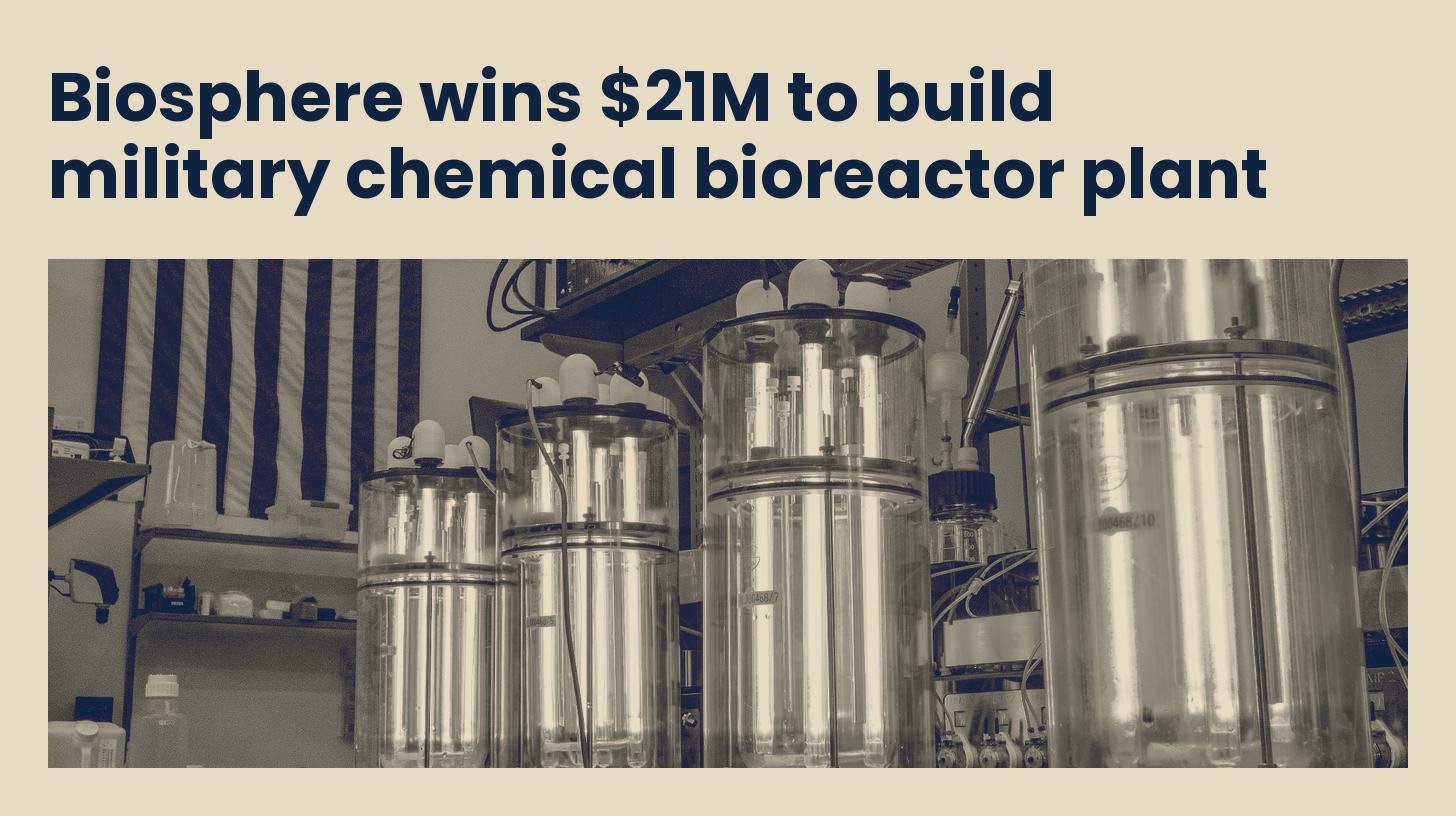
- The facility is projected to produce about 100 tons of chemicals annually and is approximately 10 times the capacity of current 1,000-liter military laboratory systems.
- Biosphere received this award less than 6 months after securing an earlier Pentagon contract worth up to $9 million for a portable bio-brewery prototype capable of producing protein from water and air.
Why it matters
- The facility directly addresses Pentagon supply chain vulnerability by creating domestic production capacity for specialty chemicals with minimal civilian market demand, reducing dependence on foreign petrochemical suppliers.
- Biomanufacturing enables production of bespoke military chemicals like advanced energetics for warheads that traditional bulk chemical manufacturers lack economic incentive to produce domestically.
- The 20,000-liter scale represents optimal sizing for military needs: sufficient volume for munitions production without the capital overhead of traditional industrial facilities, addressing persistent gaps between laboratory prototypes and commercial-scale production.
Going deeper
- Pentagon CTO Emil Michael designated biomanufacturing as one of six Critical Technology Areas, elevating biological production methods alongside traditional manufacturing rebuilding efforts.
- The military's current demand for munitions restocking is high, but historical funding volatility for energetics creates barriers for traditional manufacturers to justify domestic investment, making government-funded facilities essential.
- Biosphere's UV sterilization process and genetic engineering capabilities enable production of chemicals that petrochemistry cannot produce or produces with higher energy consumption and pollution.
Financial impact
- The $21 million represents obligated funding for facility construction with commissioning targeted Q4 2027; revenue recognition timing will follow production ramp-up after facility completion, typically in fiscal 2028.
- Biosphere's cash position benefits from $21 million in defense contract funding plus up to $9 million from the earlier portable bio-brewery contract, with timing and exercise of options not disclosed.
- The facility demonstrates cost-per-unit economics that Biosphere CEO stated can scale to larger facilities, positioning the company for potential follow-on production contracts or capacity expansion awards.
The intrigue
- Biosphere declined to disclose specifics on the 'two or three fine chemicals' the facility will initially produce beyond polymer-bonded explosives, raising questions about classified applications or early-stage product development timing.
- The company's assertion that biomanufacturing cost advantages scale to 'very large facilities' remains unproven at industrial scale, yet CEO signaled this 20,000-liter facility as a demonstration asset for future expansion.
The fine print
- The $21 million is a firm contract award, not an option or ceiling value; the earlier $9 million award to Biosphere is conditional on exercising all options, with terms not disclosed.
- Facility commissioning is targeted for Q4 2027, but construction completion and production validation timelines are not separately specified.
Source: Breaking Defense · Oct 28, 2026 · Drafted with Claude, reviewed by Industrial Base Alpha.