Mentioned:U.S. Department of Defense$67B · Government Support
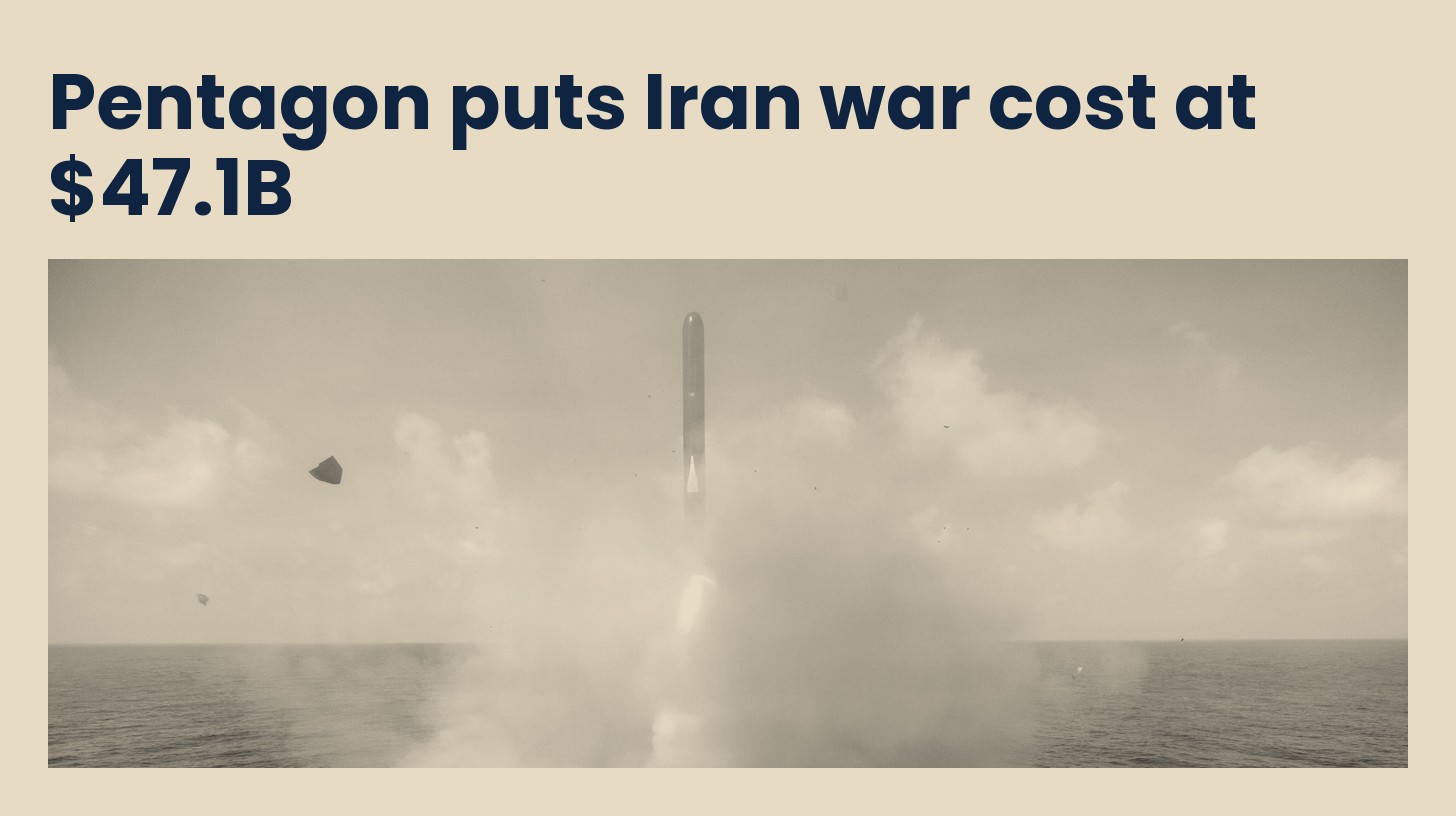
The Pentagon estimates the Iran war has cost $47.1B as of mid-October 2026, with nearly $29B required to replace expended munitions and $6.1B for lost equipment. The Defense Department is seeking $67B in supplemental appropriations from Congress to cover war-related expenses.
What's happening
- Pentagon estimates cumulative Iran war costs at $47.1B as of October 16, 2026, up from $43.6B reported in early September.
- Munitions replenishment accounts for $29B of the total estimate, while lost equipment replacement requires $6.1B, both currently unfunded.
- Military has incurred $11.9B in actual costs, including $7.6B for Air Force personnel support, airlift and operations; $2B for Army; $1.4B for Navy operations.
- DoD requested $67B in supplemental appropriations from Congress to cover war-related expenses, with funding action stalled pending midterm elections.
Why it matters
- Munitions replenishment demand of $29B signals severe depletion of inventory and urgent production requirements across the defense industrial base.
- Scale of unfunded munitions and equipment replacement needs demonstrates supply chain vulnerability and production bottleneck risks in sustained combat operations.
- Supplemental appropriation timing and size indicate Congress must rapidly allocate capital to restore munitions stockpiles and prevent operational readiness degradation.
Going deeper
- Pentagon estimate excludes damage to U.S. military assets and infrastructure in the region from Iranian attacks, still being assessed.
- Eight months into the conflict, 21 American service members have been killed and more than 850 wounded, per Senate Armed Services Committee testimony.
- U.S. has lost up to 81 aircraft and drones in the war according to prior reporting, contributing to equipment replacement costs.
Financial impact
- Supplemental appropriation of $67B will appear as mandatory spending authorization in fiscal 2026 congressional budget; funding timeline tied to election recess resolution.
- Munitions replenishment dollars ($29B) will flow to defense contractors as production contracts and deliveries accelerate in subsequent quarters pending appropriation.
- Current incurred costs of $11.9B represent obligated funds already expended; unfunded $35.2B gap ($29B munitions plus $6.1B equipment) requires congressional authorization before contractor invoicing and revenue recognition.
The intrigue
- Pentagon did not disclose damage assessment from Iranian attacks on U.S. regional bases, suggesting additional unfunded cost estimates may emerge after evaluation completes.
The fine print
- Supplemental appropriation request of $67B remains pending congressional action, with timing uncertain due to midterm election recess.
- Estimate represents costs as of October 16, 2026; ongoing operations will generate additional expenditures requiring future supplemental requests.
Source: stripes.com · Oct 28, 2026 · Drafted with Claude, reviewed by Industrial Base Alpha.