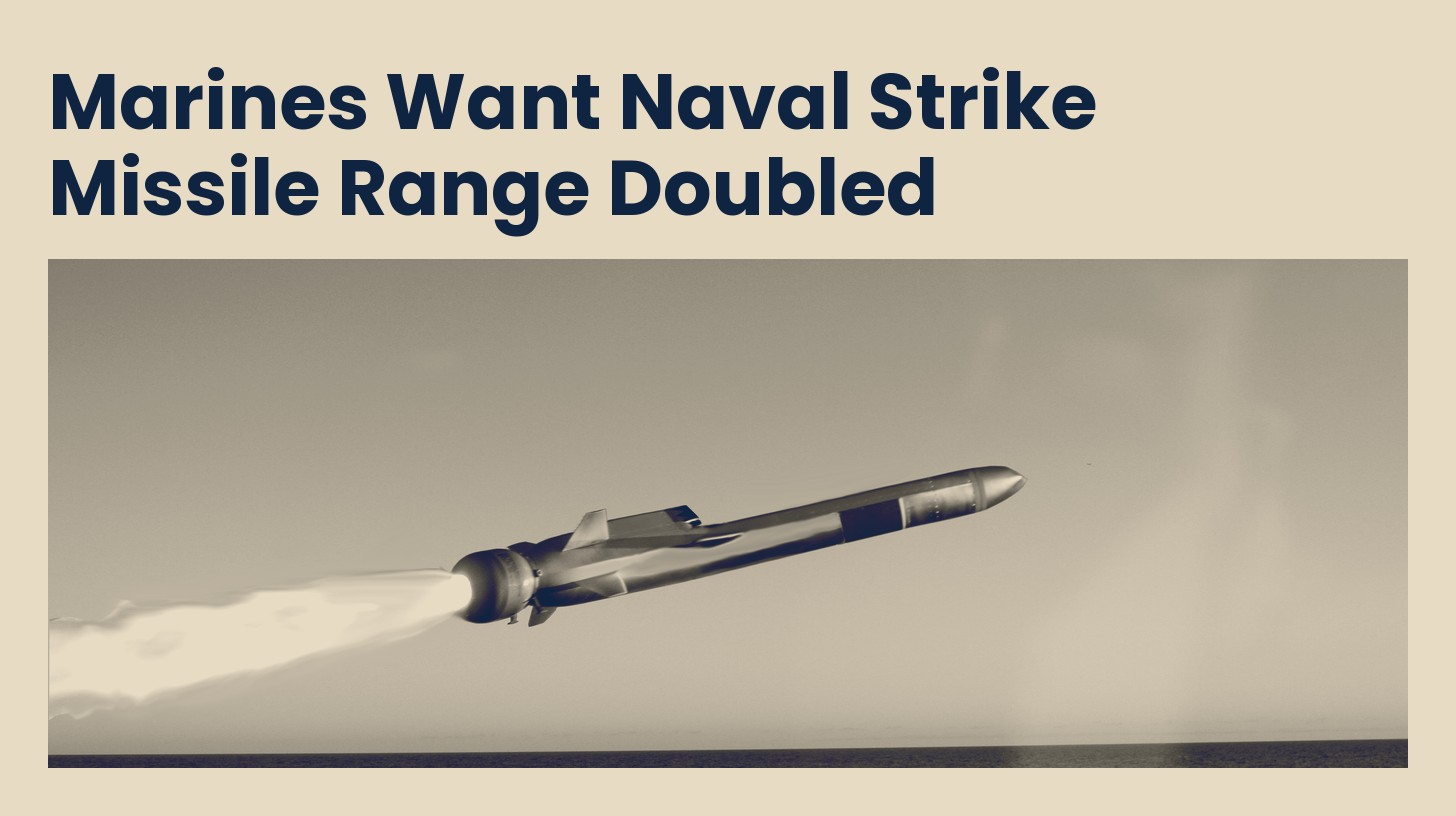
The U.S. Marine Corps is seeking to extend the Naval Strike Missile's range from 135 to 270 nautical miles or greater, a capability that would quadruple the area its ground-based NMESIS batteries can hold at risk. The range boost is central to the Corps' distributed expeditionary strategy for island-hopping campaigns in the Pacific.
What's happening
- The Marine Corps confirmed it is exploring opportunities to more than double NSM range from the current 135 nautical miles to 270+ nautical miles.
- NSM is currently deployed via NMESIS, which mounts up to two missiles on ROGUE-Fires launchers based on the Joint Light Tactical Vehicle.
- The Block 1A variant introduced in the early 2020s increased NSM range to 135 nautical miles from approximately 100 nautical miles in earlier versions.
- NSM is developed by Norway's Kongsberg in partnership with Raytheon and serves on Navy Independence class Littoral Combat Ships and experimental Arleigh Burke class destroyers.
Why it matters
- Doubling NSM range increases the area a single launcher holds at risk from 57,255 to approximately 229,022 square nautical miles, expanding sea control reach in distributed operations.
- Extended range is critical to the Corps' expeditionary concept of operations in the Pacific, enabling rapid island-to-island deployments that maintain sea denial near potential flashpoints like Taiwan.
- NMESIS elements deployed to remote locations like the Philippines and Japan's Yonaguni Island, 65 nautical miles from Taiwan, require greater standoff distance to survive in contested environments.
- The capability directly supports the Corps' anti-access/area denial strategy by allowing smaller, mobile batteries to cover strategic chokepoints like the Luzon Strait.
Going deeper
- Methods to extend range could include reducing gross weight, lowering warhead size, improving fuel economy or increasing fuel capacity, though trade-offs remain unknown.
- The Marine Corps organizes NMESIS assets into Medium Missile units with three ROGUE-Fires launchers per section, plus command and control and utility JLTVs.
- NSM uses imaging infrared seeker for terminal phase targeting and GPS-assisted inertial navigation, with passive guidance immune to radiofrequency jamming.
- The missile has stealthy features and performs high-G evasive maneuvers in terminal phase; it also carries secondary land-attack capability alongside primary anti-ship role.
The intrigue
- The Marine Corps has stated existing NSM range can exceed 135 nautical miles depending on flight profile to target, raising questions about whether extended-range variants represent new propellant technology or operational employment optimization.
The fine print
- The Marine Corps is currently exploring opportunities; no specific development timeline, funding amount or production commitment has been disclosed.
- Specific technical approaches to range extension remain unknown and no development contract award or formal program establishment has been announced.
Source: twz.com · Nov 23, 2026 · Drafted with Claude, reviewed by Industrial Base Alpha.