Mentioned:Bell Helicopter$2.1B · Program/Policy
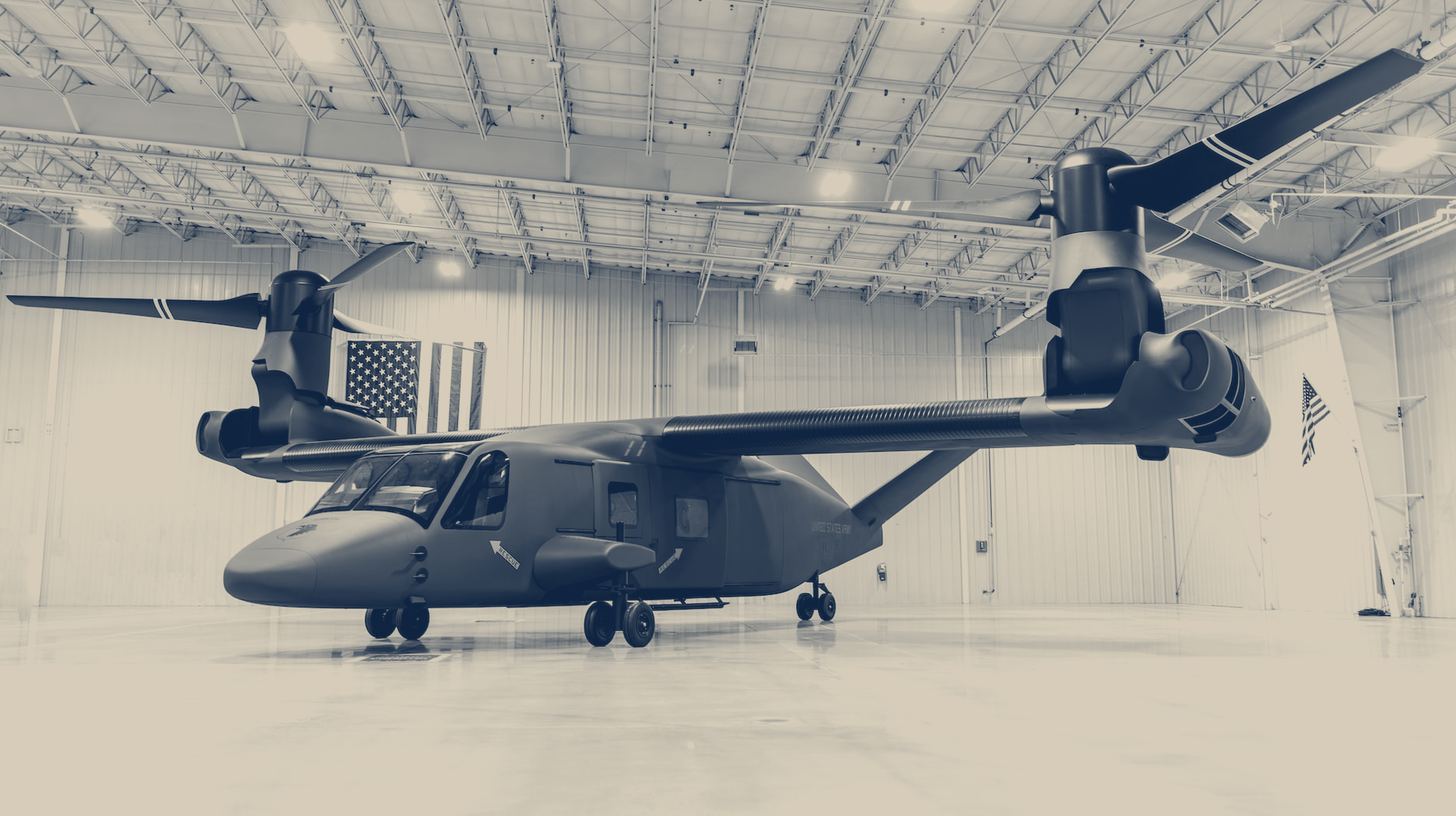
The U.S. Army is fielding Bell's MV-75 Cheyenne II tiltrotor assault aircraft to the 101st Combat Aviation Brigade at Fort Campbell in 2027, four years ahead of schedule. The Army's FY2027 budget request for the program increased to $2.1 billion from $350 million in FY2026.
What's happening
- Bell is delivering the Cheyenne II, a multi-mission tiltrotor designed to fly over 300 miles per hour, carry 14 soldiers and lift 10,000 pounds externally.
- The aircraft uses a digital-first modular open systems approach architecture allowing the Army to control maintenance and upgrades without vendor lock-in.
- The 101st Combat Aviation Brigade at Fort Campbell was selected as the first operator, with aircraft arrival scheduled for 2027 instead of the original 2031 or 2032 timeline.
- Bell is under contract to deliver six training test aircraft and two limited-use test aircraft as part of the development process.
Why it matters
- The Cheyenne II will replace part of the UH-60 Black Hawk fleet, expanding assault range and speed capabilities for Indo-Pacific operations and other theaters.
- The MOSA architecture establishes a government acquisition precedent for ownership of intellectual property and lifecycle control, avoiding vendor dependence on future upgrades.
- The accelerated 2027 delivery reduces capability gap while the Army anticipates fielding up to 334 aircraft by fiscal 2040.
- The program demonstrates government control over digital architecture for defense platforms, setting standards for future weapons system acquisitions.
Going deeper
- Bell's emphasis on cost control included designing the aircraft to use existing equipment and limiting component weights to reduce program expenses.
- The design included feedback from the 101st Combat Aviation Brigade operators, trainers and engineers who shaped features including seating configuration and open cockpit design.
- Bell is exploring future integration with Collaborative Combat Aircraft through the MOSA architecture, creating network-capable operations.
- The program office conducted design evaluations incorporating soldiers in the development process to ensure operability.
Financial impact
- Army FY2027 budget request increased to $2.1 billion in the Research, Development, Test and Evaluation framework, up from $350 million in FY2026, representing a 500 percent increase year-over-year.
- Revenue recognition for Bell will occur over the development and production period, with significant RDT&E spending in FY2027 tied to the accelerated 2027 delivery milestone.
- Timing of production milestones depends on resolution of Army leadership changes and upcoming funding discussions between Bell and Army leadership regarding feasible baseline schedules.
- Continuation Resolution risks could limit FY2027 spending if temporary funding measures extend beyond December 11, requiring contingency planning by both Bell and the Army.
The intrigue
- Bell flagged schedule feasibility concerns tied to Army leadership transitions at secretary and chief levels, with a series of meetings planned to align on funding and capability trade-offs.
- The program faces near-term funding uncertainty if a Continuing Resolution extends beyond December 11, potentially constraining FY2027 execution despite strong Congressional support in budget requests.
The fine print
- The $2.1 billion FY2027 figure is the budget request amount; actual appropriation depends on passage of fiscal 2027 appropriations legislation or another Continuing Resolution.
- Bell is currently under contract for eight test aircraft (six training, two limited-use test), not the full fleet of up to 334 aircraft anticipated by 2040.
- The accelerated 2027 delivery date was announced in January 2026 but remains contingent on alignment between Bell and Army leadership on feasible schedules and funding during ongoing discussions.
Source: Defense News · Oct 15, 2026 · Drafted with Claude, reviewed by Industrial Base Alpha.